ABC Tech Report Banner v2 MLM png

ABC Field Tech Report

rss

Case Studies for the ABC Field Tech Report

Daniel Maha, Senior Project Manager, Worth & Co.

In 2019, Worth & Co. was tasked with providing mechanical, plumbing and lab gases for the Pennsylvania Biotechnology Center in Doylestown. The project was funded by a grant with a nonnegotiable end date, which created initial concerns about the timeline. The onset of the pandemic added further uncertainty as the construction site was still deemed essential. Despite these challenges, the team at Worth demonstrated remarkable resilience and adaptability.

PLANNING AND INNOVATION

Prior to the COVID-19 pandemic, Worth, in collaboration with general contractor partner Norwood, began strategizing to tackle upcoming challenges. In the early meetings, Worth’s project team presented prefabrication concepts to the general contractor, the project design team and PA Biotech. This initiative ultimately allowed the project to be completed on schedule. The collaborative method not only streamlined the construction process but also enhanced overall efficiency.

PREFABRICATION AND BIM

Worth aimed to leverage its BIM and prefab capabilities to reduce the project schedule. Office meetings at PA Biotech became a platform for Worth to gain buy-in from trade partners, the design team and PA Biotech. Prefabrication efforts significantly cut down the timeline, which was crucial in addressing pandemic challenges. The use of BIM allowed for detailed visualization and coordination, minimizing conflicts and rework. This strategic approach not only accelerated the construction phase but also helped maintain quality standards.

VALUE ENGINEERING TO ENHANCE EFFICIENCY FOR ABOVE- AND BELOW-GROUND PIPING

The project began with value engineering aimed at improving fabrication and increasing efficiency. Worth and the design team modified the lab waste system from heavy-duty cast iron to ChemDrain CPVC, which enabled quicker installation. This change was beneficial because ChemDrain is glued, resulting in a lighter material that is easier to manage on site. This allowed Worth to fabricate a large section of the under- and above- ground piping, increasing installation efficiency on site.

To maximize efficiency in the above- ground piping, Worth prioritized coordination by collaborating closely with both the design team and various trades. It was crucial for their team to develop the optimal layout for all trades before construction began, which significantly enhanced efficiency. Worth’s team focused on installing Bang-Its and duct straps to finalize the layout. By proactively managing these elements, they ensured that hangers and materials could be installed without requiring additional layouts.

CHALLENGES AND SOLUTIONS

Installing lab gases presented a considerable challenge. Worth expedited the process by collaborating with Viega Press and its line of lab-approved fittings for nitrogen, vacuum and carbon dioxide. By utilizing Viega and its fittings, they were able to minimize the need for on-site brazing and the risk of exposure to hazardous fumes and potential fire hazards.

Limited hallway space posed another challenge. Worth’s team introduced a prefabricated rack system to house the mechanical components, which streamlined both the installation and future maintenance processes. Worth prefabricated the racks at its 75,000-square-foot prefabrication facility where they also tested and insulated all the components while on-site construction continued. This approach not only maximized the available space but also significantly accelerated the project timeline. As a result, workers were able to install an impressive 5,000 feet of piping in just four days, demonstrating both efficiency and precision in their work.

The mechanical room, often considered a difficult component because of space and time limitations, was prefabricated at Worth’s prefabrication facility. This strategy allowed the room to become operational in a matter of weeks rather than months.

ENHANCED OPERATIONAL CAPABILITIES

Without Worth’s innovative and unconventional thinking, the buy-in secured from trade partners and the design team and the dedicated efforts of the BIM department, prefab shop and field teams, completing this project within the designated time frame would have been nearly impossible due to its challenges and conditions. The lessons learned from this project have not only enhanced Worth’s operational capabilities but also gave them a new approach to tackling complex mechanical projects.

The commitment demonstrated throughout the PA Biotech project resulted in Worth returning to the Doylestown location to execute a small renovation. Their focus remains steadfast on fostering collaboration, embracing technological advancements and maintaining rigorous standards of safety and quality. More significantly, it has set the stage for new strategies and ideas to better serve all customers, including those in institutional, pharmaceutical, hospitality and general construction sectors. This positions Worth, a proud ABC member, as one of the country’s most innovative and productive merit shop mechanical and industrial firms.

Austin D. McClymonds, Ph.D., Construction Technology Integration Engineer, Leonard S. Fiore

In today’s fast-paced construction environment, accuracy and efficiency are more important than ever. Site layout, one of the first and most critical field tasks, has traditionally been a bottleneck requiring specialized surveyors and painstaking coordination. Advances in construction technology have significantly improved this process. Tools like the Topcon LN150 Layout Navigator, when paired with BIM, make layout more efficient, accurate and accessible to trained field staff.

Leonard S. Fiore, a Pennsylvania based builder known for its hands-on approach and deep self performing capabilities, is using this technology to improve productivity and coordination on complex projects. LSF has embraced this technology to shift layout from a specialized task to an integrated field operation, resulting in improved productivity, better coordination and higher quality execution across projects. LSF has established a standardized workflow for managing layout data across all projects, which consists of three key phases:

  • Model Preparation: Gathering and developing layout-specific files tailored to project requirements.
  • Field Implementation: Executing layout activities using the LN150, supported by coordinated oversight.
  • Post-Construction: Compiling and documenting as-built data to support facility management and future construction projects.

MODEL PREPARATION: PRECISION FROM THE START

Accurate and precise model preparation serves as a vital foundation for creating layout files in the field. However, the method of model preparation is influenced by the project’s scope and the specific needs of the project team.

To ensure the model aligns with these requirements, clear communication between the on-site project team and LSF’s construction technology department is crucial. This teamwork guarantees that the model assists in successful layout execution.

No matter the complexity of the project, a few essential details are always needed for a successful layout: established control points, geolocated gridlines and a CAD file that outlines the elements required for layout.

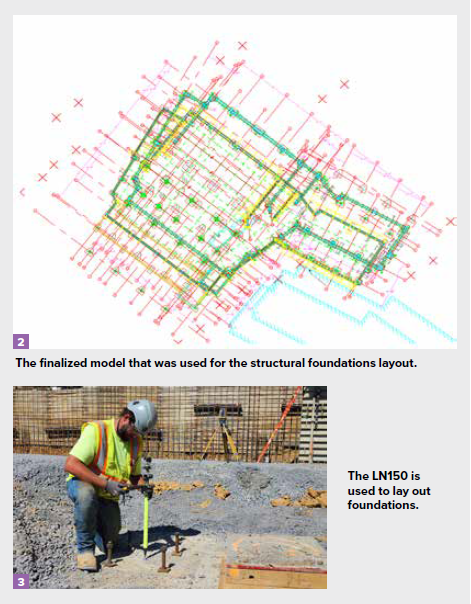
All data used to develop the layout model must be thoroughly verified against the “for construction” contract documents to ensure accuracy and readiness for field use. To illustrate this process, let us take a closer look at model preparation for one of our ongoing projects at Penn State’s main campus: the New Classroom Building. LSF’s scope of work includes the concrete package. To lay out the structural foundations, three models were developed:

  • Base Model: Contains site geometry, gridlines and control points.
  • Foundation Model: Depicts the locations of all pile caps, piles, grade beams and walls.

Concrete Form Model: Shows the exact locations of the concrete formwork used for walls. These models are carefully aligned and georeferenced to ensure consistency. Additionally, they are formatted as DWG files, where model layers and linework are simplified to reduce confusion for the LN150 operator.

Once verified for accuracy, the models are uploaded to an LN150 data collector and reviewed. Each model is loaded into the project separately to provide the operator ability to toggle each model on or off. This functionality enables the field team to confirm that the correct linework is selected for the task.

FIELD IMPLEMENTATION: LAYOUT WITH QUALITY ASSURED
Once the models are verified for quality, a coordination meeting is held with the LN150 operator, the construction technology department and the site superintendent. The purpose of this meeting is to review the layout model, confirm it meets or exceeds project expectations and ensure it is ready for field use.

After the review, the finalized models are loaded onto the LN150 data collector. The operator then takes time to familiarize themselves with the model—reviewing the linework, layer structure and layout intent—allowing them to ask questions or request clarification before work begins.

Upon arrival on site, the first step is to locate the control points established by a third-party surveyor. These points serve as the foundation for all layout activities. Using two control points, the LN150 is set up and calibrated. During setup, the instrument displays an accuracy reading, which must meet the project tolerance requirement (typically 1/16” or better). Once the setup and accuracy are confirmed, the layout process for the structural foundations begins.

To maintain quality throughout the layout process, several steps are followed. First, all laid-out lines are visually inspected to ensure they align with field conditions and construction intent. As the saying goes, “If it doesn’t look right, it probably isn’t.” In addition, the operator frequently verifies dimensions using a tape measure, cross-checking against both the model and the contract documents. In addition, the LN150 enhances jobsite quality by enabling real-time verification of critical layout elements such as wall lines, anchor bolts, formwork and elevations. This ensures that all model components are installed in their correct locations, reducing rework and improving overall accuracy.

Finally, points laid out are recorded as an as-built shot, capturing their coordinates (northing, easting and elevation). This data allows for post- layout verification and provides a record of the field layout. As-built data is consistently collected and stored for all major layout activities performed with the LN150, including—but not limited to— foundations, walls and site utilities.

POST-CONSTRUCTION: CAPTURING THE FINAL PRODUCT

Once the layout is complete, as-built data is verified and turned into a final documentation package: annotated plans, georeferenced CAD files and field notes. This data does not just close out a job; it opens the door to better facility management and future work.

Owners benefit from a reliable, digital snapshot that reflects as-built conditions, reducing future rework and giving teams a solid starting point for renovations or expansions. In this way, the as built data extends the value of the layout process beyond construction.

By leveraging BIM and tools like the LN150, LSF is not only delivering precision in the field, but also building confidence with owners, architects and trade partners. Standardizing layout workflows improves safety, accountability and project delivery.

Mihir Somalwar, Robotics and Innovation Lead, Diverge, Hensel Phelps

In today’s rapidly evolving construction landscape, field technologies play a critical role in how projects are delivered safely, efficiently and profitably. Diverge, the innovation and corporate venture arm of Hensel Phelps, is at the forefront of this movement. With a mission to support field staff by equipping them with industry-leading hardware solutions, Diverge is bridging the gap between cutting-edge startups and boots-on-the-ground needs.

At the heart of Diverge’s approach is a dual commitment: deploy proven technologies at scale, while simultaneously serving as an incubator for promising new solutions. This strategy ensures that the jobsite remains a place of continual advancement, where practical results and forward-thinking experimentation coexist.

On many Hensel Phelps projects, field staff are already benefiting from tangible tools that have demonstrated value. Technologies like the HP SitePrint layout printer, Civ Robotics’ autonomous outdoor marking robot and Trimble SiteVision’s augmented reality visualization system are now actively used in the field. Layout robotics have helped streamline the layout process on large-scale projects, particularly in data centers, by reducing the time and labor traditionally associated with manual layout. Similarly, Trimble SiteVision allows superintendents and field engineers to visualize BIM models overlaid on real-world conditions, improving accuracy during quality checks and enhancing communication with owners.

These solutions are not theoretical. They are deployed on live jobsites, improving productivity and quality assurance while reducing risk. The key to their success lies in being both user- friendly and robust enough to withstand field conditions.

While proven tools are essential, Diverge also recognizes the importance of supporting companies that have recently launched new products and are looking to partner with large, innovation- forward firms. These partnerships help introduce their solutions to real jobsites, provide critical feedback from field teams and offer opportunities for testing in realistic environments.

At Diverge’s Innovation Center in Phoenix, Diverge is engaging with startups such as Under Control Robotics, developers of humanoid robots intended for construction task automation; Hardhat Robotics, developers of teleoperated mobile robot for circuit energizations; Cyphra Autonomy, a startup building autonomous material handling robots; Ken Robotech, which recently introduced the automated rebar tying robot Tomorobo to the U.S. market; and VigilanteX, which integrates SPOT AI to provide real-time video analytics, intrusion detection and PPE compliance monitoring, among others.


“Arc flash is one of the most dangerous hazards for electrical workers,” said Henning Roedel, CEO of Hardhat Robotics, which is developing teleoperated mobile robots that allow workers to perform high risk tasks from a safe distance, while also learning from observed movements to enhance both safety and efficiency. “By partnering with Diverge and Hensel Phelps, we’re not only getting access to jobsite environments, but also the feedback and exposure we need to bring real safety innovation to the field,” said Roedel.

Companies like Cyphra, which recently graduated from incubator programs, are actively seeking partnerships with large, innovation-forward general contractors to test their platforms in live jobsite-like environments, such as the mockups and outdoor labs at the Innovation Center that simulate real project conditions. Diverge is helping them explore how their technology could support the “jobsite of the future” by addressing labor constraints and improving material logistics.

At the same time, Diverge works closely with startups to help them understand what it takes for their robots to be successfully deployed on site, while also preparing jobsites to accommodate such innovations. For instance, future jobsites may include dedicated pathways or access zones that allow autonomous material handling robots to safely transport materials from place to place. Diverge is testing these concepts and running simulations at the Innovation Center to bridge the gap between robotics development and jobsite readiness.

With Under Control Robotics, the teams are jointly designing use cases and building a dedicated testing bay at the Innovation Center. “With Diverge, we can test our product in a real-world construction environment,” said Wei Ding, CEO of UCR. “Their support gives us a safe, focused space to explore what humanoid robots can do and how they can integrate into field workflows.”

What sets Diverge apart is its incubator-like model. Instead of simply acting as a customer, Diverge builds collaborative relationships with innovators. Technologies are not just evaluated for novelty they are measured against jobsite impact, worker safety, ROI and operational integration. 

“We see Diverge not just as a technology scout, but as a real partner in development,” said Thai Nguyen, director of innovation at Diverge. “Our role is to bring together people, processes and partnerships that enable innovation to take root. It’s not just about testing new tools—it’s about collaboration, building trust and helping our teams and partners evolve together.” 

This approach has led to the creation of a robust feedback loop: Diverge brings startups into the field, collects hands-on insights and feeds them back to the development teams. It’s a process that accelerates product maturity while ensuring alignment with contractor needs.

The next frontier of construction technology isn’t just digital it’s tangible. Field-ready hardware solutions, from layout robots and autonomous material handlers to smart locks and teleoperation platforms, are poised to transform how projects are executed. Diverge is ensuring that these tools don’t just stay in research and development labs, but find their way into the hands of people who build.

By combining practical deployment with visionary support for emerging tech, Diverge is creating a future where innovation is not just a buzzword, but a daily reality on the jobsite.

Jeff Rogers, General Superintendent, Gaylor Electric

As the demand for high- performance data centers accelerates, the industry faces mounting pressure to deliver facilities faster, safer and with greater reliability. Traditional commissioning methods, particularly load bank testing, are often labor-intensive, risk-prone and time-consuming, frequently extending commissioning timelines by several weeks per phase.

Gaylor Electric’s UL-listed Whip Cart innovation redefines this process. By enabling full-path electrical testing at the server whip level, the Whip Cart not only enhances safety and quality assurance but also compresses the commissioning timeline of a 6MW data hall from weeks to mere days. There are operational, technical and strategic advantages to this breakthrough solution.

THE URGENCY OF SPEED AND PRECISION IN DATA CENTER DELIVERY

Right results matter. Period. The digital economy depends on data centers. From AI and cloud computing to streaming and remote work, the demand for scalable, resilient infrastructure is surging. As data halls grow in complexity and capacity, commissioning becomes a critical bottleneck.

Commissioning ensures that all systems—from power distribution to cooling—are fully operational before a facility goes live. However, traditional commissioning methods often fall short in both speed and completeness, delaying project delivery and increasing risk.

THE CHALLENGE: LIMITATIONS OF TRADITIONAL LOAD BANK TESTING

Load bank testing is essential for simulating real-world electrical loads during commissioning. However, conventional methods typically connect load banks directly to electrical panels or busways, bypassing critical downstream components such as cords, plugs and metering devices. This approach introduces several key limitations:

  • Incomplete Testing: Fails to validate and stress-test the full electrical path, leaving potential issues undetected.
  • Safety Risks: Requires operating on open and energized panels, increasing the risk of arc flash incidents.
  • Labor-Intensive: Demands extensive manpower and procedural overhead, including Method of Procedure documentation.
  • Extended Timelines: Sequential testing of components and systems can stretch commissioning over several weeks, especially when complex MOPs require time-consuming setup changes.
  • Reliance on Rental Equipment: Load bank testing often involves sequences that can last up to eight hours. Any interruption to this process by equipment failure necessitates a restart of the testing, thereby wasting valuable time.  

THE SOLUTION: WHIP CART TECHNOLOGY

Developed in-house by Gaylor Electric, the Whip Cart is a mobile, field-deployable system engineered to streamline and enhance load bank testing. Unlike traditional methods, the Whip Cart connects directly to the server whips the same cords that will power the servers in production.

KEY CAPABILITIES:

  • Full-Path Testing: Validates the entire electrical path from panel to plug, including cords, plugs and metering devices.
  • Plug-Level Connection: Eliminates the need to access live panels, significantly reducing safety risks.
  • Mobility and Modularity: Easily repositioned to support rapid, parallel testing across multiple circuits.

QUANTIFIABLE IMPACT: FROM WEEKS TO DAYS

The Whip Cart’s most transformative benefit is its ability to compress commissioning timelines. By

enabling simultaneous Level 3 and Level 4 testing—which are traditionally performed sequentially—the Whip Cart:

  • Reduces handoffs between teams
  • Minimizes setup and teardown time
  • Accelerates issue detection and resolution
  • Facilitates server rack installation in parallel with commissioning

In a recent project for an Edged data center, Gaylor Electric demonstrated exactly that. A data hall with 6MW of critical power normally requiring three to six weeks to fully test was validated in just two days.

HERE’S WHAT WAS INVOLVED:

  • (48) 400-amp power panels, each feeding 22 individually metered server whips
  • (48) 400-amp circuit breakers
  • (24) 800-amp automatic transfer switches
  • (2) massive 3,000-amp reserve busways

Every circuit was individually metered, stress-tested and verified with infrared scanning and meter validation.

The result? A complete, high-fidelity commissioning process done in a fraction of the time, with full documentation to back it up.

FIELD-PROVEN BENEFITS

  • Enhanced Safety: Arc flash exposure is eliminated by avoiding live panel access, and cords are kept elevated and organized to reduce trip hazards.
  • Operational Efficiency: No MOPs are required for panel access, which streamlines the process significantly. This approach reduces both labor hours and the number of personnel needed for the job. Additionally, the system allows for rapid deployment and easy repositioning across various test zones.
  • Superior Quality Assurance: Integrated infrared scanning detects hot spots and faulty connections in real time, enabling proactive issue resolution that reduces rework and delays.
  • Comprehensive Validation: This process confirms the performance of metering devices and downstream infrastructure at maximum rated load, providing a more accurate representation of real-world operating conditions.

STRATEGIC ADVANTAGE: COMPETITIVE DIFFERENTIATION

In a competitive market, the ability to deliver faster, safer and more reliable commissioning is a clear differentiator. The Whip Cart positions Gaylor Electric as a leader in innovation, offering clients faster time to market, reduced risk exposure and higher confidence in system performance.

LOOKING AHEAD: SCALING THE INNOVATION

The Whip Cart is an established component of Gaylor Electric’s commissioning strategy. By owning and operating our own fleet of whip carts, load banks, load cables, communications and control systems, Gaylor Electric ensures unmatched quality and control at every stage of the process. This unique capability empowers our teams to consistently deliver work of the highest caliber, regardless of project scale or complexity. Future enhancements aim to expand the Whip Cart’s application across more project types and service lines, reinforcing our commitment to continuous improvement and client success.

Reliable Resources. Reliable Outcomes. Reliable Insights. Genuine Care for People. The future of data center commissioning is here exclusively with Gaylor Electric.

Sam Burns, Director of Virtual Design and Construction, Balfour Beatty

At Balfour Beatty, we’ve built our legacy on collaboration, and continuous improvement. As the commercial construction landscape evolves, so too do the tools and processes we rely on to deliver in the field. One area that has seen dramatic transformation in recent years is field layout a critical step in translating design drawings into the physical structures that we are entrusted to build.

Today, we’re seeing a shift from manual measurements and string lines to automated layout solutions that harness the power of robotics, laser scanning and BIM-integrated workflows. These technologies are not only enhancing accuracy they’re helping us build smarter, safer and more efficiently.

FROM TAPE MEASURES TO TOTAL STATIONS

For centuries, field layout has been a mostly manual process. Crews have relied on chalk lines, measuring tapes and printed drawings to translate dimensions to the field. While effective, this approach is labor-intensive and prone to compounding errors.

The introduction of robotic total stations marked a major turning point. When paired with BIM and layout software, RTS empower a single operator to perform the same layout work that previously took a two-person crew. Layout points could be uploaded directly from a coordinated model and precisely staked in the field with millimeter-level accuracy.

At Balfour Beatty, these systems have become a standard part of our field toolkit enabling tighter tolerances, improved quality assurance/quality control and faster field verification.

BRIDGING BIM AND THE FIELD

The integration between BIM coordination and layout workflows has unlocked new levels of efficiency. Rather than waiting for 2D drawings, layout teams can now extract points directly from federated models, minimizing translation errors and reducing downtime. We’ve seen measurable benefits on complex MEP-intensive projects, where accurate hanger and embed layout early in the schedule translates to fewer clashes, smoother inspections and reduced rework.

AUTOMATION AND ROBOTICS ON THE RISE

The future of layout is not just about digitizing old processes it’s about automation and scalability. New tools like the Dusty Robotics FieldPrinter and HP SitePrint are making it possible to perform layout of interior walls, doors and overhead MEP with unmatched efficiency. Multitrade layout can now be performed in one step, resulting in all trades now building from the same single source of truth. “Modern layout tools like robotic printers and laser scanning have transformed fieldwork, delivering real gains in speed and accuracy. But rework remains a significant risk. It is critical that proper quality control of layout files happens early in the process to minimize errors before they reach the field,” explained Justin Cadwallader, Balfour Beatty senior VDC manager.

ACCURACY, ACCOUNTABILITY AND REDUCED REWORK

At its core, the evolution of field layout is about reducing risk. Every misaligned sleeve or misplaced embed carries downstream impacts costly rework, loss of productivity and strained relationships with trade partners.

Todd Stewart, Balfour Beatty operations director, put it best, saying, “How we perform field layout has evolved significantly in recent years. With smarter tools and stronger pre-planning efforts, we’re improving efficiency and reducing rework delivering greater value to our clients and trade partners.”

By connecting our layout workflows directly to coordinated BIM models and leveraging advanced tools like robotic total stations, laser scanners and layout robots, we’re achieving:

  • Tighter installation tolerances
  • Fewer change orders due to misalignment
  • Enhanced documentation of as-built conditions

These capabilities not only improve project outcomes but also strengthen trust with owners, designers and trade partners who depend on Balfour Beatty and our trade partners to deliver with precision.

QUALITY CONTROL AND CHECKING FIELD ROUGH-IN

Despite advances in layout technology, rework still occurs and the earlier it’s identified, the less disruptive it is. To support early detection, we leverage digital tools that visually compare installed conditions against the coordinated model.

Solutions like Procore BIM AR, Gamma AR and others allow teams to perform rapid visual checks in the field. When discrepancies are identified, they trigger a deeper review process that may include manual measurements, laser scanning and collaboration with project stakeholders to pinpoint the root cause. This isn’t just about fixing the issue it’s about learning from it. By analyzing where communication or coordination broke down, we can refine our workflows and reduce the likelihood of recurrence. These feedback loops are essential to improving layout accuracy and minimizing downstream impacts.

THE ROAD AHEAD

At Balfour Beatty, we’re continuing to explore technologies that enhance layout validation through AR overlays, AI-driven quality checks and autonomous robotic workflows. But even as the tools evolve, our focus remains the same: reducing rework on our projects and empowering our people to build with confidence, efficiency and excellence.

Because when layout is done right, the rest of the project follows suit.


Paul Hedgepath, Director, MJ Harris Construction

At MJ Harris Construction, precision drives everything we do. Several years ago, we added Trimble X7 laser scanning and Trimble robotic total stations to our technology toolkit. Since then, they have completely changed how we capture, verify and integrate project data. The reason was simple: when working on complex renovations and additions, accuracy and speed are the difference between meeting deadlines and missing them.

CAPTURING EXISTING CONDITIONS OUR BIGGEST WIN

Laser scanning has quickly become our most valuable tool for documenting existing conditions. Whether capturing mechanical systems, architectural features or structural components, the Trimble X7 delivers a highly accurate point cloud that drops directly into our BIM workflow. This allows us to make informed decisions about what stays, what goes and how new designs will integrate with the existing structure.

For addition projects, scanning the interface points between old and new construction eliminates guesswork. We can model the connection points with millimeter precision, preventing clashes and ensuring a seamless fit.

EXPANDED USE CASES ACROSS PROJECT TYPES

While documenting existing conditions is a major benefit, these tools have proven useful in many other areas, including:

  • Structural steel verification: Ensuring beams, columns and bracing are installed exactly as designed before subsequent trades begin.
  • MEP coordination: Scanning overhead mechanical, electrical and plumbing systems to confirm alignment with BIM coordination models before ceilings are closed.
  • Facade documentation: Capturing detailed geometry of existing building facades for restoration or integration with new design elements.
  • Site logistics planning: Using scans to model site constraints, crane placement and material laydown areas for better sequencing.
  • Pre-pour slab checks: Confirming rebar placement, embeds and blockouts are correct before concrete placement.
  • Post-pour verification: Checking slab elevations and flatness immediately after placement to catch deviations early.
  • As-built documentation: Providing owners with precise records of what was built, down to the millimeter.
  • Historic preservation: Digitally preserving ornate or aging features before restoration work begins.

FLATNESS ANALYSIS FLOORS, SLABS AND ROOFS

Flatness scanning has proven its worth time and again:

  • Concrete floors: Verifying new and existing slabs meet tolerance requirements before finishes are installed—or even during the pour for real-time adjustments.
  • Roof renovations: Confirming slope and levelness to ensure drainage and long-term performance.

Scanning entire surfaces instead of relying on spot measurements provides documented proof, speeds decision-making and eliminates costly rework.

BEYOND MEASURING VERIFICATION AND QUALITY CONTROL

Laser scanning offers speed, accuracy and detail far beyond traditional methods. Measuring with tape or total stations alone could take weeks and still miss the mark. With the X7’s in-field registration, scans can be processed on-site and the data turned around quickly.

Using the X7’s precision together with Trimble robotic total stations allows us to oversee both broad area scans and pinpoint layout checks with confidence. Whether it’s verifying steel placement, confirming MEP systems, checking concrete work or performing full scan-to-check comparisons against design tolerances, we know exactly where we stand before the next phase begins.

RETURN ON INVESTMENT WHY IT MATTERS

Laser scanning and robotic total stations have delivered measurable ROI across our projects:

  • Speed: Rapid capture and verification without multiple site visits
  • Accuracy: Consistent millimeter-level precision
  • Confidence: Clear visual proof that builds trust with owners and design teams
  • Reduced rework: Catching discrepancies early before they become costly
  • Better coordination: Sharing scan data directly with all project stakeholders

BE THE DIFFERENCE

By embracing advanced scanning and layout technologies, we’ve raised the bar for project certainty, quality and efficiency. At MJ Harris Construction, it’s not just about using cutting-edge tools, it’s about ensuring every project starts and ends with precision.

Amr Raafat, Chief Innovation Officer, Windover

A digital twin is a comprehensive 3D model that provides a virtual replica of a physical building and uses real-time data, simulations and artificial intelligence to monitor, analyze and optimize performance. By integrating IoT sensors, building information modeling and AI-driven analytics, digital twins create a dynamic, data-rich model that continuously updates to reflect changes in the physical building. Windover has been utilizing digital twin technology to capture critical building information during construction and create valuable tools for owners that transform the handover process and revolutionize the way buildings are managed post-construction.

While the industry standard has been to hand over cumbersome manuals and PDF drawings at the end of a project, leaving most clients with unhelpful documentation for facility management, Windover has employed cutting-edge technology to provide clients with easily accessible data. As a standard practice, Windover’s virtual, design and construction team coordinates all projects throughout the design and build phases. However, they realized that all the valuable data created during the BIM coordination process was lost when the project was handed over to the client.

Windover knew its clients could be using this data for facility management, but the information was lost in the documentation they were providing. Windover sought a solution that would extend its technology to its clients, ideally incorporating BIM data without requiring expertise in specific software. Windover began employing digital twin technology using Autodesk’s Tandem software to take fully coordinated models developed during construction and provide clients with an accurate replica of their building that could also hold facility management data like warranties, installation dates, service schedules, manufacturer information and much more. Taking it a step further, Windover has also incorporated IoT sensors, building BIM and AI-driven analytics to provide real- time insights into building performance.

As today’s-built environment grows increasingly complex, building owners and facility managers face mounting challenges in maintaining operational efficiency, sustainability and safety. Digital twin technology is changing how facilities are managed by providing real-time data, predictive insights and advanced operational control. By creating a virtual replica of a physical building, digital twins enable owners to optimize resources, streamline maintenance and simplify the overall user experience. Key benefits of digital twins for facility management include:

  • Real-Time Monitoring: A digital twin offers a real-time, virtual representation of a building or facility, enabling managers to monitor operations and systems (HVAC, lighting, etc.) continuously. This visibility enables early detection of performance issues, thereby reducing downtime.
  • Enhanced Energy Efficiency: Digital twins continuously monitor and analyze energy usage within buildings, identifying inefficiencies and recommending optimizations. By integrating IoT sensors and AI-driven analytics, facility managers can adjust HVAC, lighting and water systems in real time, reducing waste and lowering utility costs. This leads to more sustainable operations, helping owners meet their environmental goals.
  • Predictive Maintenance: One of the biggest challenges in facility management is unexpected equipment failure. Digital twins use predictive analytics to forecast when critical systems, such as HVAC, elevators and electrical grids, are likely to fail. By proactively scheduling maintenance, owners can avoid costly disruptions, extend the lifespan of assets and ensure a safe and functional environment for occupants.
  • Improved Space Utilization: With fluctuating occupancy, evolving hybrid learning and working models, and dynamic usage needs, optimizing space is more important and more complex than ever. Digital twins provide detailed in- sights into user preferences and room utilization, enabling facility managers to allocate space more effectively. This ensures that offices, classrooms, labs and communal areas are used efficiently, reducing underutilized real estate and enhancing the user experience.

Digital twins are revolutionizing building operations, providing facility managers with the tools they need to optimize efficiency, sustainability and safety. Digital twins are especially effective as universities are leveraging this technology to create smarter, more connected campuses. At Endicott College in Beverly, Massachusetts, Windover has implemented cutting-edge technology like digital twins, IoT sensors, BIM, laser scanning and drone surveys across the campus to transform how the college manages and optimizes its facilities.

Endicott partnered with Windover to deploy digital twin technology across its 235-acre campus, starting with the newly completed Cummings School of Nursing and Health Sciences, and then opting to implement the technology on multiple existing buildings, creating an interconnected smart campus. With real- time data from IoT sensors and advanced modeling, Endicott has gained unparalleled visibility into building operations, energy use and predictive maintenance, saving time, reducing costs and enhancing the overall campus experience.

This digital twin integrates everything from HVAC systems to security infrastructure, allowing Endicott to simulate scenarios and proactively address challenges before they become costly issues. The result is a smarter, more efficient and future-ready campus.

The use of comprehensive digital twins, which combine BIM and operations and maintenance data with IoT sensors, is not only transforming the handover process and empowering facility managers after construction, but also enhancing the entire lifecycle of construction. By leveraging data-driven BIM and quality assurance/quality control workflows, the industry can build better, smarter and more sustainable facilities.

Nino Efendić, President And Drone Specialist, Aerial Prospex

Aerial Prospex developed an autonomous drone system that lives on your jobsite and delivers real-time visibility, without anyone needing to fly it. This system can fly on a schedule, on demand or seconds after a triggering event such as when motion is detected after hours.

The system’s drone docks are weatherproof charging stations that house a drone, charge its batteries, upload data to the cloud and enable repeatable, automated flight missions, all without human intervention. Once deployed on site, the dock connects to power and the internet runs fully off-grid thanks to the AP Dock Ops Trailer. From that moment on, your jobsite is covered from above.

Flights can be scheduled daily, weekly or in response to milestones, deliveries or change events. The data collected includes high-resolution progress photos, 2D site maps, 3D models and more. Contractors, superintendents and project stakeholders can monitor job progress, document changes and resolve disputes faster, without waiting on a survey crew or walking the site.

With drone docks, you get smarter awareness, fewer surprises and better decisions—every day.

HOW DRONE DOCKS ARE BEING USED

Drone docks are being deployed across residential, commercial and infrastructure projects to provide jobsite intelligence that is faster, more consistent and easier to access. Contractors are using this technology to fill critical visibility gaps without increasing labor or pulling teams off task.

REAL-WORLD RESULTS: WHEN DOCUMENTATION PAYS OFF

A recent hillside stabilization project quickly turned into a case study in how real-time documentation can make or break a job. The slope had partially collapsed, and the solution involved cutting back the hillside and rebuilding a solid foundation of fill.

The initial estimate for the site work was $250,000. But as soon as crews started stripping the stone off the pad, it became obvious: the volumes were way off. The stone base was deeper, the failure more extensive and the fix more complex than expected. Luckily, a drone dock had already been deployed on site.

From Day 1, the dock was flying daily missions automatically capturing aerial imagery and calculating cut-and-fill quantities. Within the first week, the data made it clear that the site work was going to far exceed the original estimate. The contractor brought this to the owner’s attention immediately. The owner’s response? “Keep working—we’ll tell you when to stop.”

So they did.

Each day, the drone flew. The crews kept cutting, filling, placing and stockpiling. Quantities were tracked.

Progress photos were uploaded and shared with the owner and engineer. Every movement of earth was documented, and every dollar of progress was backed by hard data.

Months passed. The site work bill had climbed to nearly half a million dollars, and the job was only three-quarters done. That’s when things got tense.

Despite having received weekly reports and visuals the entire time, higher-level decision-makers within the owner’s organization began to push back. They questioned the price, claimed they had only approved $250,000 and refused to release further payments.

But the contractor had what most don’t: daily evidence.

Every day was documented with geotagged photos, accurate drone- calculated volumes and a historical archive of progress reports. There was no ambiguity. Faced with that level of documentation, the owner had no choice but to honor the work completed and issue payment in full.

This level of tracking would have been nearly impossible using traditional methods. The site crews were in constant motion: cutting and filling, stockpiling and placing, often doing several things at once. Daily surveys would’ve been cost- prohibitive, and walking the site wouldn’t have captured enough detail. The drone dock, on the other hand, captured everything consistently, passively and without slowing the crew down.

In this case, the drone dock didn’t just provide visibility, it protected the contractor’s bottom line.

WHAT TO TAKE AWAY

Drone docks aren’t just flying cameras; they are jobsite tools that deliver consistent, automated, real-time visibility. Think of them as a daily survey crew, documentation specialist, site security and progress tracker rolled into one, but without adding labor or slowing down the field.

For contractors, this means fewer surprises, faster decisions and solid proof when it matters most. Whether you’re managing earthwork, tracking deliveries or protecting your margins, drone docks give you the eyes, data and documentation you need without anyone having to lift a finger.

And when it comes to cost, drone docks deliver significant value. While pricing depends on your region and the type of data delivered, flights from a drone dock typically cost 50% to 75% less per mission than hiring a drone pilot to do the same work manually.

This isn’t future tech. It’s field-proven, already working today and built to scale across your jobs.

Stephen Jones, Senior Director, Industry Insights Research, Dodge Construction Network

The construction industry suffers from a chronic disconnect between what happens in real time at the jobsite and the decision-making activities occurring back at the office. This information asymmetry where one party has better access to critical data than another impacts productivity, cost control, schedule compliance and profitability.

Construction companies are revolutionizing the ways they gather, analyze and report on field data to improve their project performance, profitability and competitiveness.

TECHNOLOGY IMPROVEMENTS ALSO CREATED OBSTACLES

Over the past several decades, technology to support office- and shop- based activities has proliferated—from estimating, scheduling and accounting to BIM and fabrication. Meanwhile, field operations have benefited from site-oriented technologies such as automated timekeeping, cameras, drones and IoT for site monitoring and progress tracking, ruggedized tablets and increasingly sophisticated robotics.

However, these office and field advances typically operated as discrete “silos of excellence” for their small groups of users. As a result, site data would still require manual transfer to office systems and decision-making was based on outdated information. Contractors had more data than ever before, but less actionable intelligence.

THE DRAIN ON PROFITS

A financial impact of that gap is revealed in the Top Business Issues for Specialty Contractors study focusing on the root causes of profit margin erosion for

five types of specialty trade contractor (mechanical, electrical, plumbing, steel and concrete).

  • While the average gross profit margin reported is 21%, respondents say they are losing about 6% to a variety of inefficiencies.
  • They cite poor project reporting between field and office as one of the main reasons for this profit erosion.
  • The lack of standard methods, appropriate technology and mobile tools to streamline communication are named as top causes of this poor communication.

TECHNOLOGY IS EVOLVING TO ENABLE CONNECTIVITY

Encouragingly, there is a growing recognition across the industry that connectivity, not just capability, is the key to optimizing technology’s potential. The convergence of mobile networks, cloud computing and multifunctional software platforms now enables integrated digital workflows that make it easier to share information reliably with the field and among project partners. Technology tools that work well together can leverage field data for better decision-making and can also ensure that all the work done in preconstruction is implemented effectively in the field.

CONTRACTORS ARE PRIORITIZING FIELD DATA

The Improving Efficiency with Field Data & Construction Project Performance Metrics study illustrates this growing focus on connected field data. It examines how general and trade contractors gather, store, manage, secure, analyze and report on five aspects of field activity—project progress, work hours, productivity, safety and equipment management:

  • Nearly two-thirds (64%) of respondents have actively improved their field data gathering and analysis capabilities over the previous three years.
  • They report numerous benefits from these efforts, including better budget and schedule compliance, improved safety performance and greater productivity and profitability.

The findings about their plans for handling field data further reinforce this dramatic shift:

  • Where paper forms and spreadsheets were once dominant, only 17% predict a continued reliance on them in the future.
  • Over 80% say custom and commercial software will be their main tools going forward.
  • Mobile capabilities of cloud-based solutions will be a top driver for migrating away from legacy, premise- based software.

INTEGRATED DIGITAL WORKFLOWS HELP TO IDENTIFY ROOT CAUSES OF FIELD-RELATED PROBLEMS

Newer field technology solutions are designed from the ground up to enable integrated multiparty workflows, where digital tools share data seamlessly and key tasks are automated to facilitate collaboration and efficiency.

The Connected Construction SmartMarket Brief examines the root causes of construction operations problems related to five specific field-focused activities: field ticket management, crew time entry, work order management, safety process management and work progress tracking. It reveals that:

  • About 90% of general and trade contractors who actively deploy integrated digital workflows to conduct these processes report they can trace the root causes of the construction operations problems they experience.
  • By contrast, less than half of those who do not leverage integrated digital workflows for these processes are able to identify these root causes.

The inherent visibility and record keeping of digital workflow processes are essential to help construction companies analyze and reduce field-related performance issues and optimize the value of field data.

Achieving a seamless information flow between jobsites and project offices will enable real-time decision-making based on current, complete and consistent data. Companies that learn to treat their field data as a strategic asset will gain sustainable competitive advantages through improved project performance, enhanced profitability and the ability to tackle increasingly complex projects with confidence across distributed teams and locations.